The 2027 Medicare Advantage and Part D Star Ratings were released on October 8, 2026. They will drive 2028 Quality Bonus Payments and rebates, and they arrive in a year when CMS reweighted outcomes, retired several high-scoring measures, and introduced new medication safety measures. On the surface, performance looks steady. When you dig deeper into the data, the path to 4 and 5 stars became much narrower than years prior, indicating future quality bonus payments are going to be even harder to achieve.
How MA plans performed in the 2027 Star Ratings
Among the 468 MA-PD contracts rated in both Stars Year (SY) 2026 and 2027:
- More plans lost ground than gained it. 39% of contracts declined in overall rating, 42% held steady, and only 19% improved.
- Double the number of contracts were below the 4-star line as the number above the bonus threshold. 72 contracts fell below 4 stars, while 35 moved up to 4 stars or higher.
- The average contract rating declined again, from 3.75 to 3.62.
Across all rated MA-PD contracts:
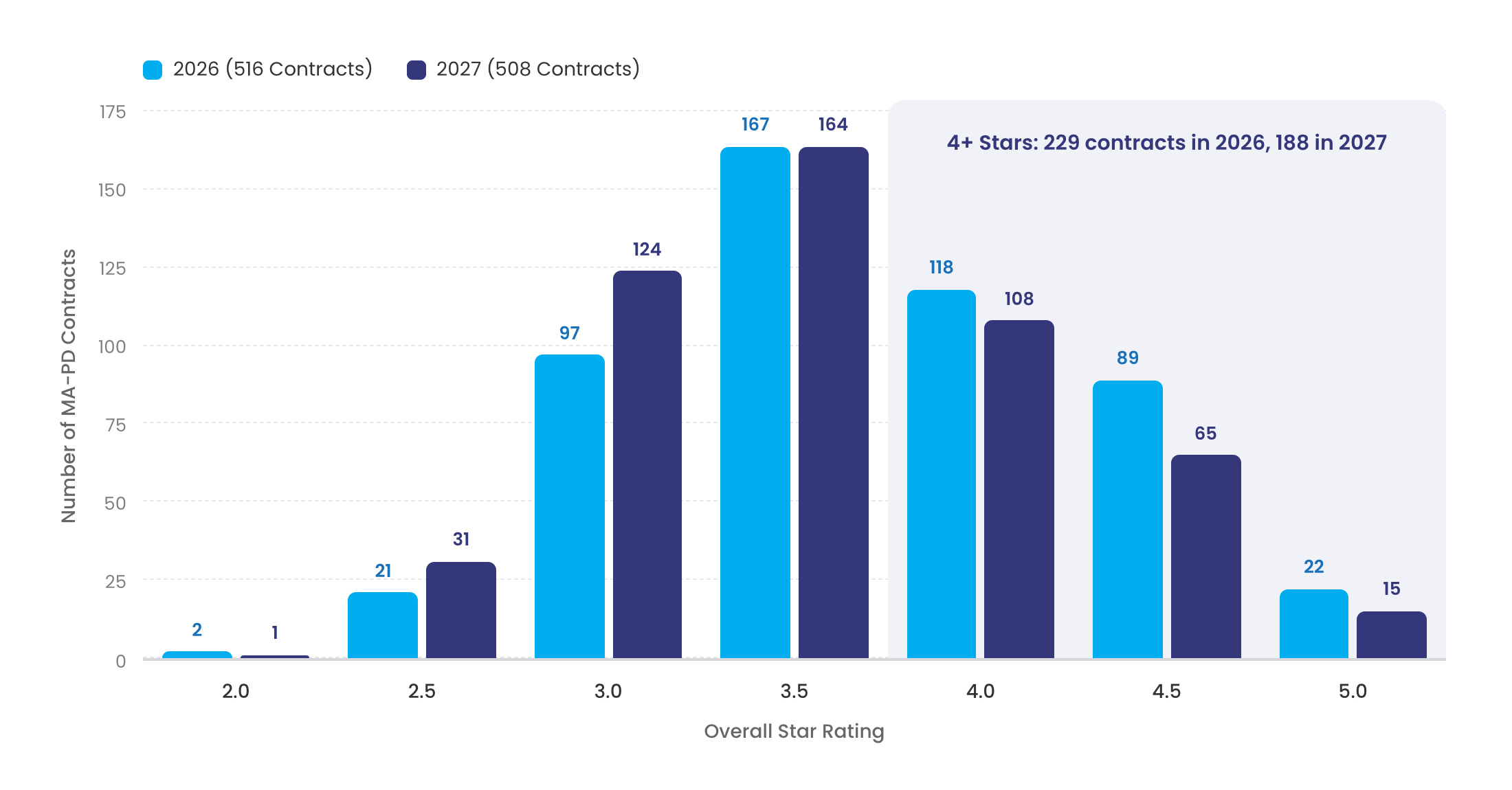
- 188 contracts (37%) earned 4 stars or higher, down from 229 (44%) in 2026.
- Five-star contracts fell from 22 to 15. Seven of the 15 are new to the top tier: five moved up from 4.5 stars and two were rated for the first time.
- All 15 five-star contracts are local coordinated care plans, and 13 of them are SNPs.
Five highlights from SY2027
1. The industry improved, but the bar moved faster
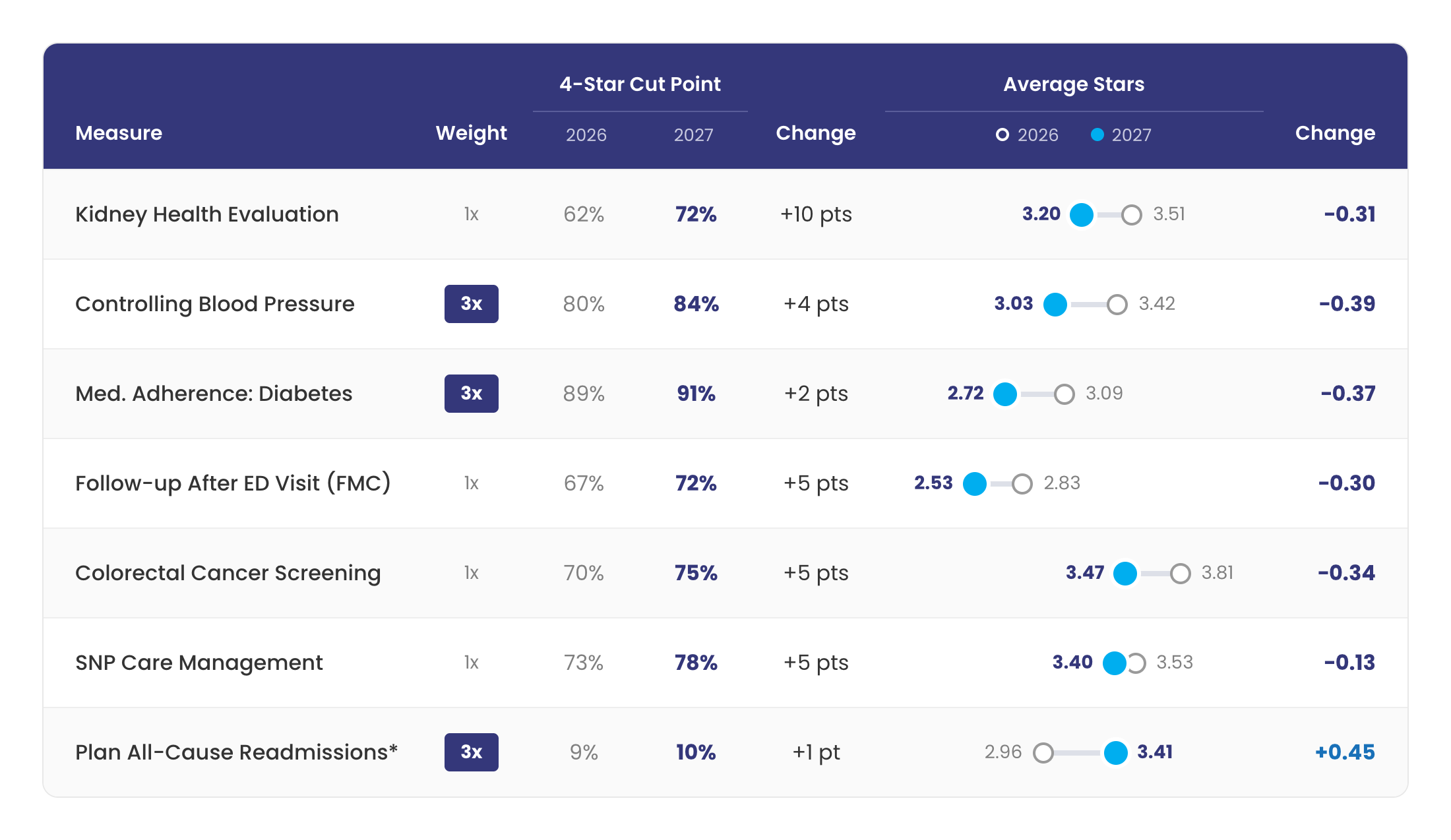
Median plan performance rose on most clinical measures in measurement year 2025. Cut points rose more, so the same or better performance earned fewer stars.
- Kidney Health Evaluation (KED): The median rate climbed 7 points, yet the 4-star threshold jumped 10 points, from 62% to 72%. Average stars fell from 3.51 to 3.20.
- Controlling Blood Pressure (triple-weighted): The median rose from 79% to 81%, but the 4-star cut point moved from 80% to 84%. Only 30% of contracts earned 4+ stars, down from 47%.
- Medication Adherence for Diabetes (triple-weighted): The median improved 2 points and the 4-star cut point rose 2 points. Average stars fell to 2.72, the lowest of any adherence measure, with 45% of contracts at 1 or 2 stars.
- Follow-up After ED Visit (FMC) and SNP Care Management: 4-star cut points rose 5 points each.
- Colorectal Cancer Screening: The respecified measure entered as new, with no guardrail on cut-point movement. The 4-star threshold rose from 70% to 75%.
- Plan All-Cause Readmissions was the one exception. Average stars rose from 2.96 to 3.41, giving plans a rare tailwind on a triple-weighted outcome.
2. The decline was concentrated in special needs plans (SNP)
Among contracts rated in both years, the share of SNP contracts at 4+ stars fell from 45% to 33%. Non-SNP contracts barely moved, going from 47% to 46%.
Part of the drop comes down to which measures went away. For 2027, CMS retired:
- Care for Older Adults (COA) Pain Assessment
- Medication Reconciliation Post-Discharge
- MTM Completion Rate for CMR
Each averaged 3.7 stars or higher in 2026, so plans lost points they could count on.
The SNP model can still win. Thirteen of the 15 five-star contracts are SNPs, and they averaged a perfect 5 on COA Medication Review, the returning COA Functional Status Assessment, and Osteoporosis Management. What sets them apart is tight execution on the care management and clinical documentation measures that remain.
3. Outcomes now carry more weight, starting with HOS
CMS tripled the weight of the Health Outcomes Survey (HOS) Improving or Maintaining Physical and Mental Health measures. Together they now make up about 7% of the MA-PD overall weight. For about two-thirds of the contracts rated on HOS, the change pulled their weighted measure average down, based on Healthmine’s modeling of measure stars at the old and new weights.
Physical Health is the bigger problem. It averaged 2.98 stars, and 41% of rated contracts earned 1 or 2 stars. It also does little to separate top performers: 4-star plans averaged 3.06 stars on Physical Health, compared with 2.92 for everyone else. Today, HOS is a drag on nearly every plan, which leaves room for the plans that invest early to pull ahead.
4. What separates 4-star plans from the rest
Healthmine compared average measure stars for 4+ star contracts against contracts below 4 stars, then factored in weight. The biggest gaps sit in a familiar set of measures:
- Triple-weighted intermediate outcomes: Blood Sugar Controlled (4.45 vs. 3.28), Controlling Blood Pressure (3.74 vs. 2.63), and all three Medication Adherence measures, each with a gap of about 1 full star.
- Quality Improvement measures (weight 5): High performers kept improving year over year. Both Part C and Part D improvement measures declined industry-wide, which raises the value of steady gains.
- Member experience: CAHPS Rating of Health Care Quality, Rating of Health Plan, and Customer Service each showed a gap of about 1 star.
5. New measures are already separating plans
- Concurrent Use of Opioids and Benzodiazepines (COB): Averaged 3.48 stars in its first year, with a 4-star threshold of 12% or lower.
- Polypharmacy: Anticholinergic Medications (Poly-ACH): Averaged 3.38 stars, with a 4-star threshold of 7% or lower.
- COA Functional Status Assessment: Returned with a high bar. The median SNP rate was 93%, and 4 stars required 87%.
Methodology under legal scrutiny
The Clover Health court ruling which determined that CMS improperly calculated the plan’s Star Ratings by including 20 measures led to CMS recalculating some 2026 ratings. Appeals are ongoing as more insurers filed lawsuits following the Clover decision.
Plans should know exactly which measures drive their scores.
What’s changing for 2028 and 2029 Star Ratings
- 2028 Star Ratings (measurement year 2026, closing now): Call Center Interpreter and TTY Availability and Statin Therapy for Patients with Cardiovascular Disease are removed.
- 2029 Star Ratings (measurement year 2027): CMS removes the appeals measures, SNP Care Management, Complaints, Members Choosing to Leave, MPF Price Accuracy, and two CAHPS measures. Depression Screening and Follow-Up is added, and MTM Completion Rate returns as a new measure.
- What this means: the measure set is shifting away from administrative measures and toward clinical, outcome and behavioral health measures that depend on member action.
The path forward: Recommended next steps
Now through December 31 (measurement year 2026 close-out)
- Prioritize the triple-weighted measures. Focus remaining outreach on members with open blood pressure and blood sugar gaps. Confirm that blood pressure and A1c results are captured through supplemental data and CPT II codes, not just claims.
- Target to next year's cut points, not this year's. Build goals that assume continued cut point increases, and add a buffer on measures like KED, CBP, FMC, and Colorectal Cancer Screening.
Measurement year 2027 planning (2029 Star Ratings)
- Build a year-round HOS strategy. With HOS outcomes now triple-weighted, engage members on physical activity, fall prevention, bladder control, and emotional health before survey windows rather than during them.
- Protect the SNP advantage. Hardwire COA Functional Status Assessment and Medication Review documentation into care management workflows and strengthen post-discharge and post-ED follow-up for transitions of care and FMC.
- Prepare for Depression Screening and Follow-Up. Establish screening workflows and behavioral health referral pathways in 2027, the first measurement year for this measure.
- Get ahead of the new Part D safety measures. Pair pharmacy analytics with prescriber outreach and policy adjustments to reduce opioid-benzodiazepine overlap and multiple anticholinergic use.
- Shift resources as measures retire. Redirect effort from removed administrative measures toward measures that depend on member engagement and clinical follow-through.
- Keep CAHPS in view. Member experience still separates high performers. Use every interaction ahead of the 2027 CAHPS survey to reduce friction in getting care and appointments.
Healthmine delivers on clinically driven measures
Health plans working with Healthmine weathered the tough scoring for 2027 Stars better than the national averages, with a higher percentage of Healthmine clients earning 4+ stars and Quality Bonus Payments.
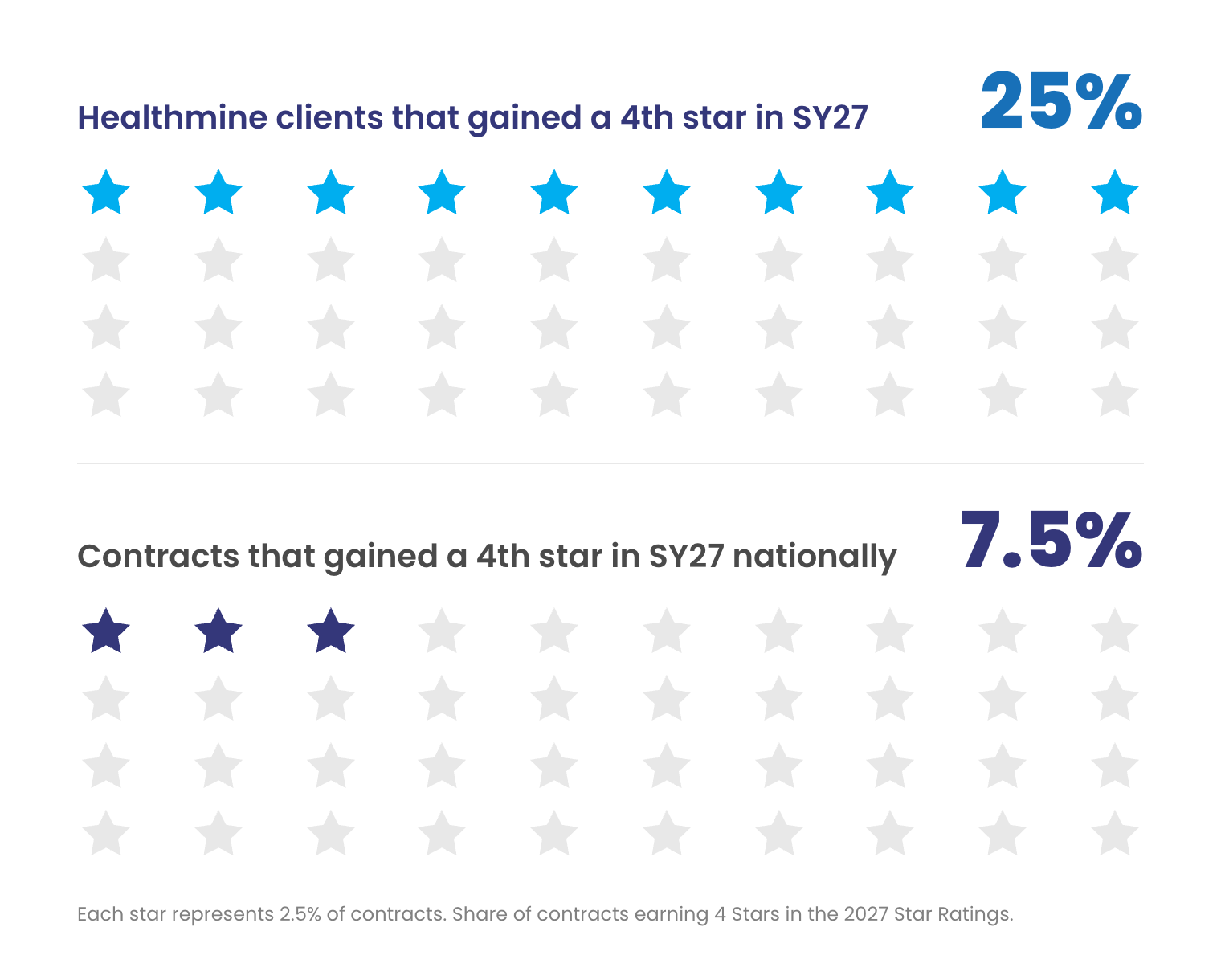
Across all of our contracts, measures with Healthmine-led outreach and engagement performed 0.27 stars higher than measures outside the program. That lift currently applies to the measures each plan has prioritized so far, and Healthmine's catalog can drive engagement across all non-admin measures. Heading into 2027, we're helping clients bring more health actions into their programs and carry that performance across more measures.
With Healthmine’s QRM® and QRM Connect™ solutions, health plans gain:
- Real-time gap visibility so teams can see which members are closest to closing a triple-weighted gap and act fast
- Multi-lingual and CMS-aligned outreach templates and incentives that move members to complete screenings, refills and follow-up visits
- Scheduling assistance that matches members with providers and books appointments without requiring a call to the provider office, facilitated through RCS, email and agentic phone calls
- HOS- and CAHPS-informed engagement that improves member experience and reported health outcomes year-round
Don't miss the opportunity to finish measurement year 2026 strong and set up 2027 for success. Find out how Healthmine can bridge the gap between engagement and meaningful Stars results. Contact us today to partner with Stars experts that will develop a data-driven engagement framework specific to your health plan.
Summary
- Only 37% of Medicare Advantage Prescription Drug (MA-PD) contracts earned 4 stars or higher in the 2027 Star Ratings, down from 44% in 2026, and five-star contracts fell from 22 to 15.
- Cut points rose faster than plan performance. The Kidney Health Evaluation (KED) 4-star threshold jumped 10 points, and only 30% of contracts earned 4+ stars on triple-weighted Controlling Blood Pressure.
- Special needs plans (SNPs) took the biggest hit. The share of SNP contracts at 4+ stars fell from 45% to 33%, partly because CMS retired three high-scoring measures.
- The measure set is shifting toward outcomes that depend on member action. HOS Physical and Mental Health measures tripled in weight, and the 2029 Star Ratings add Depression Screening and Follow-Up.
- Measures with Healthmine-led outreach performed 0.27 stars higher than measures outside the program. Healthmine's QRM® and QRM Connect™ helps health plans close triple-weighted gaps, book visits, and improve HOS and CAHPS results year-round.

Ana brings more than 20 years of healthcare and health plan experience to Healthmine. She most recently came from WellSense Health Plan, formerly Boston Medical Center HealthNet Plan. She had oversight of work related to Stars, HEDIS®, NCQA, Quality Rating System, External Quality Review Organization, population health programs, new product implementation, value-based care programs, policy advocacy and health equity programs.
Ana developed multiple innovative member and provider interventions that were integral in the successful improvement of key HEDIS and Consumer Assessment of Healthcare Providers and Systems (CAHPS) quality measures and meeting corporate and contractual goals. She has experience with successfully identifying and implementing new to industry initiatives, such as texting, with proven quality and financial improvement. Ana is bilingual in English and Spanish and has used this in community initiatives to help engage members and improve the quality of care for the Medicaid, Medicare, Affordable Care Act, and Commercial populations.
Ana holds a master’s degree from Simmons University in Health Administration and a bachelor’s degree from the University of New Hampshire.